Gerry Lynch and Richard Marshall: New Works
Satellite Gallery
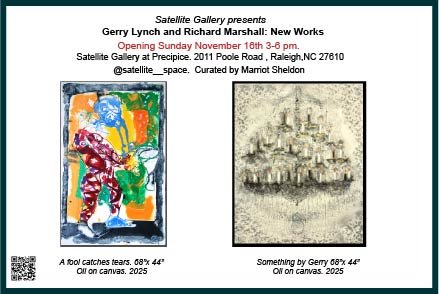
Lyrical beauty cleaves with and from deeper reality in “Gerry Lynch and Richard Marshall: New Works”, the enticing show opening in November at Satellite Gallery. From the whimsical, ethereal beauty in Gerry Lynch’s “Chandelier” Series to Richard Marshall’s meditations on death and desire highlighted by “Perspective Device”, these works present new avenues of brilliance from two of Raleigh’s most gifted artists. Marshall’s works punctuate his 40-year career, bringing an always brilliant use of color and technique to search again for the enigmatic truths hidden within plain sight. The seriousness of most Lynch paintings — a vast array of abstracts over decades as one of North Carolina’s most important artists — is here layered beneath her gently rendered chandeliers.
Marshall’s human shapes in several of the show’s paintings rise from Kandinsky-like form to unveil soulful iterations of existential voids. Tethers sprout from his imagination, here as colors and lines that climb the canvas and disperse themes of dreams, death, and desire. “Perspective Device” calmly juxtaposes sex and intellect, letting the viewer decide where love reigns and lust posts its gambit. And the jaunty, small canvas “Piles of Things” slams against the seriousness of finite time and misplaced priorities. It is art at its best: beautiful, enigmatic and provocative. Yet, it’s “Don Quixote Dreams of the Spanish Civil War” that underscores the integration of idea and form that punctuates Marshall’s position among our city’s best artists. “Quixote” delivers itself into an evocative space with imaginative, bold colors that spring figures off the canvas. Perfect symmetry and lively strokes let the viewer contemplate not just the protagonist’s heroic quest, but one’s own, as mortality bursts out of masterful oranges and blues and reds.
For Lynch, the grand themes of life explored in her previous Islamic abstracts now find themselves cast into the seemingly simple chandelier. Her ingenuity steers away from the possible kitsch of such forms and transports the viewer toward larger ideas of mortality and fragility. Love and hope surge from her luminous marks and gilded forms. Lynch’s 50 years of releasing art into the ether culminates quite simply in “Line Chandelier, No. 33”, an autonomic work that emerges on the canvas in three-dimensional wisdom. Its lines push into the viewer’s consciousness, forming questions on the role of beauty in dark times. Lynch releases mournful elegance into the rooms where her art lives, each canvas offering a playful wink at the serendipity that underscores being alive.
Marshall and Lynch complement each other, not just in the paintings seen here but in their lifetime of works. There is an odd symmetry between the bold abstract themes of Lynch’s forceful canvases and the calliope of shapes and colors that spring from Marshall’s mind. Lynch began her career late, in her early 30’s, but in the fifty years of non-stop work since has explored a multitude of ideas. Lynch’s art spans mediums beyond painting, including neon tubes and found objects constructed into clattering mobiles. Each piece exists in the service of art as clarity, as emancipation from the human condition. Marshall’s paintings, collages and videos challenge the viewer to escape from everyday thinking. His artistic muses rise from the abstractions of Gorky, the fluidity and brilliance of Monet and the radical insurrections of Duchamp. These new works underscore his steadfast belief in the virtues of complexity, kindness and certitude of purpose.
— Greg Rideout